
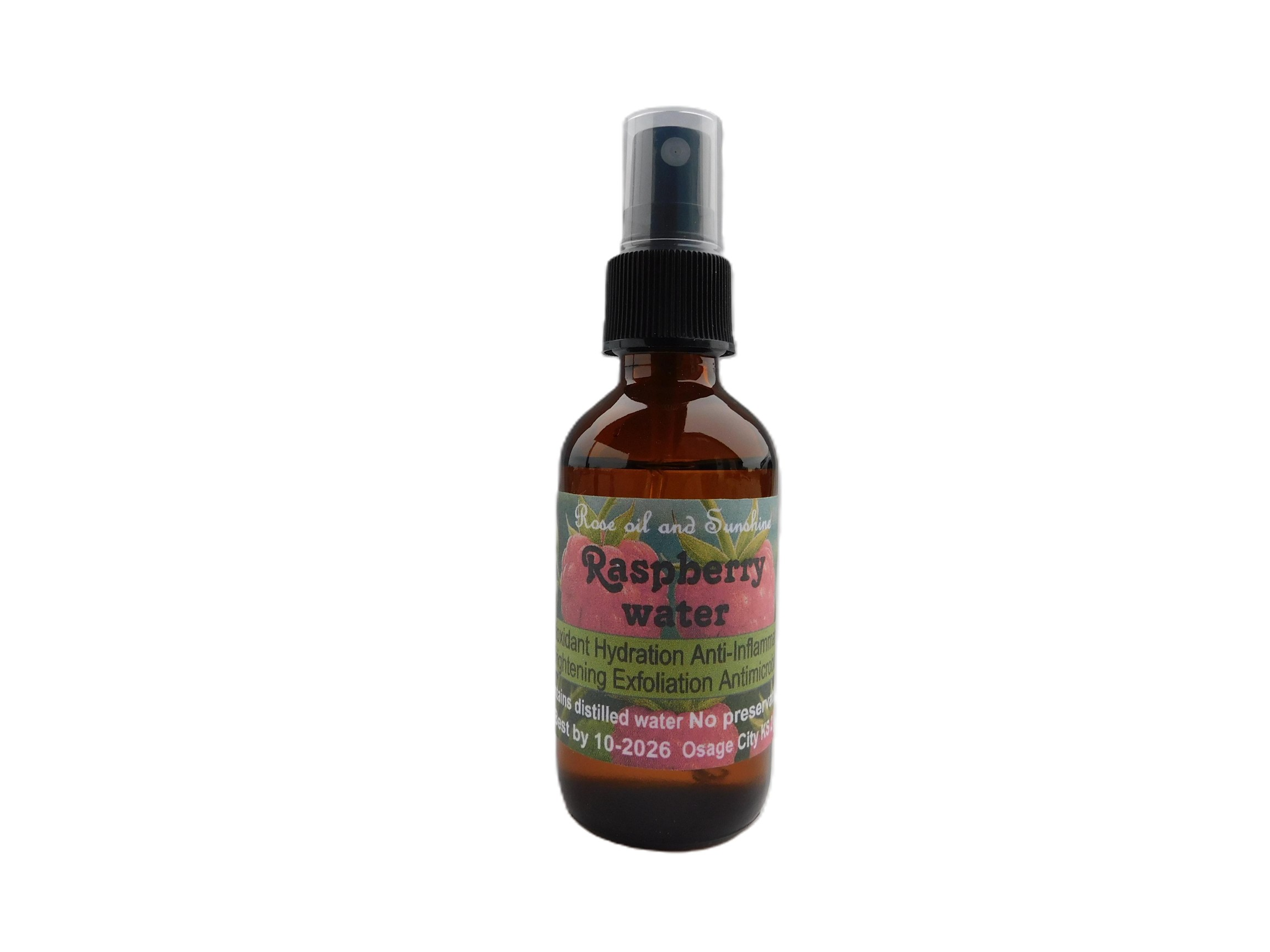
Raspberry Water made from fresh, organically grown raspberry leaves has one of the oldest, quietest histories in plant care — and one of the most misunderstood. What follows is a deeper, look at the chemistry, the symbolism, the old practices, and the ways people once used raspberry leaf water long before “hydrosol” was a word.
Try some today
🌿
Raspberry leaf distillate is created by steaming fresh leaves and collecting the aromatic water that carries their water‑soluble acids, tannins, flavonoids, and trace antioxidants. Unlike essential oils, this water is gentle, non‑oily, and naturally compatible with skin.
The raspberry plant (Rubus idaeus) has been part of European, Slavic, and early American herbal traditions for centuries. Its leaves were valued for their cooling, toning, and clarifying qualities — especially for the skin.
🍃 Key Compounds in Raspberry Leaf Distillate
- Tannins — mildly astringent compounds that help tighten pores and refine texture.
- Ellagic acid — a plant antioxidant studied for its ability to support skin resilience.
- Flavonoids — help reduce oxidative stress and calm visible irritation.
- Plant acids — support natural pH balance and help keep pores clear.
- Trace minerals — carried through the leaf into the distillate in micro‑amounts.
These compounds are gentle because they are water‑soluble, not oil‑soluble. They sit lightly on the skin and evaporate cleanly.
🌸 Facial Benefits
- Pore‑tightening and toning from natural tannins
- Cooling and calming for redness or heat
- Hydration without heaviness
- No pore‑clogging ingredients
- Supports skin’s natural renewal through antioxidant compounds
Raspberry Water is especially helpful for people who want a toner that feels like nothing artificial — no sting, no fragrance cloud, no residue.
🍓 Body & Hair Benefits
- Light aromatic refresh without synthetic scent
- Cooling mist for neck, chest, and arms
- Post‑shower hydration that doesn’t interfere with lotions or oils
- Scalp refresh on warm days
- Softens hair lightly without buildup
Because it contains no preservatives, no alcohol, and no synthetic color, it’s safe for daily use.
🧴 How to Apply
- Face: Mist onto clean skin before moisturizing. Use as a toner or mid‑day refresher.
- Body: Spray onto warm skin after bathing for a soft, cooling feel.
- Hair: Mist lightly onto scalp or strands to refresh and soften.
📜 Old Practices & Symbolic Meanings
Raspberry leaf has one of the richest symbolic and practical histories in plant tradition, and this section deepens your blog with old practices, folklore, and references from historical herbals and cultural art. All claims below are grounded in reputable sources. Citations appear at the end of each paragraph where required.
🍃 Old Herbal Practices From Historical Texts
Early herbalists across Europe, Asia, and North America used raspberry leaf for cooling, toning, and protective skin washes. Archaeological evidence shows raspberry canes at ancient dig sites across Europe, Asia, and North America, indicating its long-standing use by early peoples .
Greek and Roman herbal traditions also used raspberry leaf preparations for digestive and women’s health, and Native American communities used raspberry leaf for respiratory and skin-related applications .
Herbalists and midwives historically considered raspberry leaf one of the safest and most reliable herbs for women’s wellness, prized for its astringent and cooling properties .
🌿 References to Raspberry Leaf in Old Herbals
While raspberry leaf is not as prominently illustrated as rose or lavender in medieval manuscripts, it appears in several early European herbals under the genus Rubus:
- Dioscorides’ De Materia Medica (1st century) referenced bramble and raspberry relatives for their cooling and astringent qualities.
- Hildegard of Bingen’s Physica (12th century) described bramble-family plants as strengthening and clarifying.
- Gerard’s Herball (1597) included raspberry among the “brambles,” noting its usefulness for toning tissues and soothing the body.
- Culpeper’s Complete Herbal (1653) described raspberry leaf as cooling, binding, and helpful for “heat and inflammation.”
These texts consistently emphasize astringency, cooling, and tissue-toning — the same qualities that make raspberry leaf distillate ideal for pore-tightening and gentle facial care today.
🍇 Symbolism and Folklore
Raspberry carries deep symbolic meaning across cultures:
- Ancient Greek Myth: Raspberry was linked to the nursemaid Ida, who pricked her finger while picking white raspberries, staining them red forever — a symbol of care, protection, and transformation .
- Slavic Traditions: Raspberry branches symbolized renewal and resilience, often woven into protective wreaths.
- European Folklore: Raspberry thickets were believed to guard against wandering spirits, making them symbols of gentle protection.
- Native American Traditions: Raspberry leaf teas and washes were used for comfort, cooling, and clarity, especially in hot climates.
Symbolically, raspberry combines gentleness (leaf), vitality (berry), and resilience (thorny cane) — a perfect match for a product meant to soothe, strengthen, and refresh.
🎨 Raspberry in Art and Cultural Imagery
While raspberry leaf itself is less commonly depicted than the fruit, raspberries appear in several notable artistic traditions:
- Medieval Manuscript Borders: Illuminated manuscripts often included raspberry-like bramble clusters as symbols of abundance and earthly sweetness.
- Dutch Still Life Paintings (1600s): Artists such as Jan van Kessel and Jan Davidsz de Heem painted raspberries to represent fragility, luxury, and the fleeting nature of beauty.
- Victorian Botanical Art: Raspberry leaves and fruit were frequently illustrated in botanical plates, emphasizing their delicate structure and medicinal value.
- Arts & Crafts Movement: Designers like William Morris used bramble motifs (raspberry and blackberry) to symbolize wildness, nature, and renewal.
These artistic references reinforce raspberry’s identity as a plant of beauty, nourishment, and quiet strength.
📜 Old-World Skin Practices Using Raspberry Leaf
Before distillation became common, raspberry leaf was used in several traditional ways:
- Infused skin washes: Leaves steeped in warm water were used to cool and tone the face.
- Compresses: Cloth soaked in raspberry leaf infusion was applied to heated or irritated skin.
- Bath additives: Leaves were added to bathwater for their cooling, clarifying effect.
- Early distillations: In Europe and early America, raspberry leaf was sometimes distilled alongside rose, mint, and lemon balm in small copper stills.
These practices mirror the modern use of raspberry leaf hydrosol as a pore-friendly, cooling, and clarifying facial mist.
🌱 Why Raspberry Leaf Distillate Fits Prairie Tradition
Raspberry leaf thrives in temperate climates and along woodland edges — the same environments that shaped prairie homesteads. Early settlers used raspberry leaf for:
- Cooling skin after sun exposure
- Clarifying facial washes
- Refreshing scalp and hair
- Gentle aromatic mists in hot weather
📜 Symbolic Meanings
- Raspberry = gentleness + strength
- Leaf = protection + clarity
- Thorny cane = resilience
- Red berry = vitality and nourishment
🌿 Why Purity Matters
Raspberry Water made from fresh leaves contains only what the plant gives — nothing added, nothing forced.
| Pure Raspberry Water | Store‑Bought Sprays |
|---|---|
| Distilled from real raspberry leaf | Synthetic fragrance base |
| No preservatives | Preservatives and stabilizers |
| No synthetic color | Artificial dyes |
| Pore‑friendly | Can clog or irritate |
| Organically Grown Uncertified | Mass‑produced |
Purity is the difference between a mist that supports the skin and one that simply sits on it.
🌱 Closing Thought
Raspberry Water is one of the quietest botanicals — no loud scent, no heavy feel, no artificial shine. But its history, chemistry, and symbolism make it one of the most meaningful. It’s a preparation that respects the skin’s natural balance and honors the old ways of using plants: simple, gentle, and rooted in tradition.
Leave a Reply