
Understanding the Difference Between Traditional Oils and Industrial Seed Oils
There’s a lot of confusion out there about oils, especially when people say “all oils are the same.” They’re not — and the history explains why.
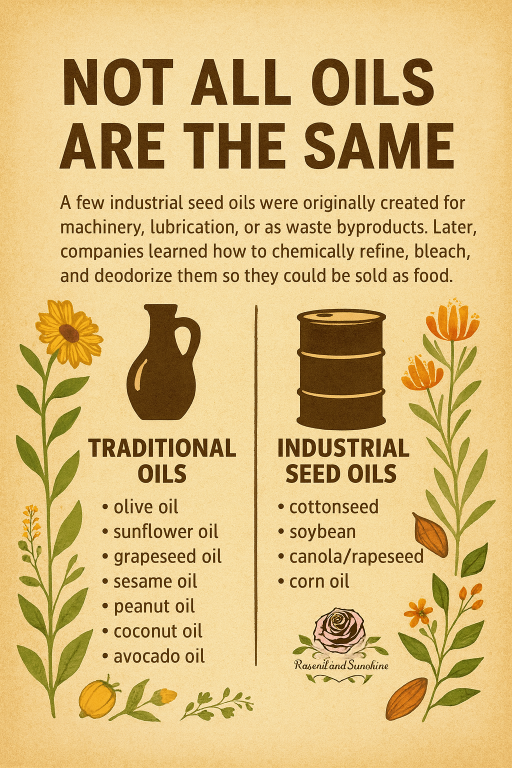
A few industrial seed oils were originally created for machinery, lubrication, or as waste byproducts. Later, companies learned how to chemically refine, bleach, and deodorize them so they could be sold as food.
Those oils include:
- cottonseed
- soybean
- canola/rapeseed
- corn oil
These required heavy industrial processing before they were considered edible.
But that history does not apply to traditional food oils.
For thousands of years, people have used:
- olive oil
- sunflower oil
- grapeseed oil
- sesame oil
- peanut oil
- coconut oil
- avocado oil
These come straight from plants and have long culinary and cultural roots. They don’t start as industrial byproducts, and they don’t require harsh chemical refining to be usable.
The difference comes down to origin and processing:
Traditional oils
• pressed from fruits or seeds
• used as food for generations
• minimal processing
Industrial seed oils
• originally made for machinery or industry
• only edible after heavy refining
• often sold as “vegetable oil” blends
So yes — some industrial oils were pushed into the food supply over time. But that doesn’t make all oils the same. Their plant sources, history, and processing methods are completely different.
A little clarity goes a long way.
| Traditional Food Oils | Industrial Seed Oils |
|---|---|
| Olive Oil | Cottonseed Oil |
| Sunflower Oil | Soybean Oil |
| Grapeseed Oil | Canola / Rapeseed Oil |
| Sesame Oil | Corn Oil |
| Peanut Oil |
🌿 How Some Oils Start Good… and Then Get Made Worse for Profit
There are three main ways this happens:
- Thinning or blending with cheaper oils
- Over‑refining to strip out natural compounds
- Using aggressive chemical processing to increase yield
Let’s break each one down in plain language.
1. Thinning or Blending With Cheaper Oils
This is the most common trick.
A company starts with a decent oil — olive, sunflower, avocado — and then cuts it with cheaper industrial seed oils like:
- soybean
- canola
- corn
- cottonseed
Why?
Because the profit margin jumps instantly.
This is why “extra virgin olive oil fraud” is a documented global issue.
A bottle can legally say “olive oil” even if it contains a blend.
What gets lost:
- antioxidants
- aroma
- stability
- flavor
- skin benefits
What gets gained:
- shelf life
- profit
2. Over‑Refining: Taking a Good Oil and Stripping It Down
Some oils start out fine — but then companies refine them to death so they:
- look clearer
- smell neutral
- last longer
- are cheaper to produce
Refining removes:
- color
- scent
- plant compounds
- antioxidants
- natural stability
What’s left is a pale, flat, lifeless oil that behaves more like a neutral industrial product than a food or skincare ingredient.
This is how a “good” oil becomes a commodity oil.
3. Chemical Processing to Increase Yield
This is where the “chemically refine, bleach, and deodorize” part comes in.
To squeeze every last drop out of seeds, companies use:
- solvents (often hexane)
- high heat
- bleaching clays
- steam deodorizing
This process:
- increases yield
- lowers cost
- destroys natural compounds
- creates an oil that must be stabilized artificially
This is how industrial oils — originally used for machinery — were transformed into “vegetable oil.”
🌾 The Bottom Line
Some oils are good at the start, but profit-driven processing can turn them into:
- thinned blends
- over‑refined products
- chemically stripped oils
Meanwhile, traditional oils (olive, sunflower, sesame, coconut, avocado) stay closer to their natural state when they’re:
- cold‑pressed
- lightly filtered
- minimally processed
This is why your whole‑plant infusions stand out — they’re rooted in tradition, not industrial shortcuts.
🌿 How to Pick a Good Oil
1. Choose oils that come from real food
If people have eaten it for centuries, it’s usually a good sign:
- olive
- sunflower
- sesame
- peanut
- coconut
- avocado
Avoid oils that started as industrial byproducts:
- soybean
- canola/rapeseed
- cottonseed
- corn oil
These require heavy chemical refining.
2. Look for “cold‑pressed,” “unrefined,” or “extra virgin”
These terms mean:
- no chemical solvents
- no bleaching
- no deodorizing
- minimal heat
The oil stays closer to its natural state.
3. Avoid “vegetable oil” blends
“Vegetable oil” is a marketing word that usually means:
- a mix of cheap industrial seed oils
- refined until all color and scent are removed
It tells you nothing about the plant source.
4. Check the color and scent
Good oils:
- have a natural aroma
- have color (greenish olive oil, golden sunflower, etc.)
- don’t smell like plastic or nothingness
Over‑refined oils are pale and odorless.
5. Look for single‑origin or single‑ingredient oils
A bottle should say:
- 100% olive oil
- 100% sunflower oil
- 100% sesame oil
If it says “blend,” “light,” or “pure,” it’s often thinned.
6. Choose oils packaged in dark glass
This protects the oil from:
- light
- heat
- oxidation
Plastic can leach into oil over time.
7. For herbal infusions: pick stable, traditional oils
The best infusion bases are:
- olive oil (most stable)
- sunflower oil (light, absorbs well)
- sweet almond oil (gentle, traditional)
- jojoba (technically a wax, very stable)
Avoid grapeseed for long infusions — it oxidizes quickly.
🌾 The Deeper Explanation
A good oil is one that:
- comes from a plant traditionally used as food
- is extracted without harsh chemicals
- retains its natural compounds
- hasn’t been thinned with cheaper oils
- hasn’t been bleached or deodorized
- hasn’t been overheated to increase yield
This is why traditional oils behave differently from industrial seed oils.
One is pressed from fruit or seeds.
The other is manufactured through chemical refining.
Leave a Reply